
Key Takeaways
Anxiety lesson plans help students understand the difference between normal worry and anxiety that lasts longer, feels more intense, and interferes with school, work, or relationships.
Effective lessons combine psychoeducation, body awareness, coping strategies, positive self talk, and practice in real life school scenarios.
Students learn best through low prep visuals, role play, reflection, writing, movement, small group discussion, and repeat practice.
School support works best when teachers, counselors, family members, and outside mental health providers coordinate next steps.
When symptoms become severe, Adolescent Mental Health’s virtual IOP can provide more intensive CBT, DBT, group, individual, and family therapy for teens ages 12–17.
Introduction: Why Anxiety Lesson Plans Matter in 2026 Classrooms
Teen anxiety has remained a major school concern since 2020. In 2023, about 16.1% of U.S. adolescents ages 12–17 had diagnosed anxiety, and in 2024, 19% reported moderate to severe anxiety symptoms, according to federal and KFF data. Students may avoid school, freeze during tests, panic before presentations, or feel anxious after social media conflict with friends.
This guide is for a teacher, counselor, psychologist, nurse, or mental health staff person supporting students ages 10–17. The goal is not to diagnose children, but to encourage students to recognize signs, talk about feelings, and practice positive coping skills.
Adolescent Mental Health provides a virtual intensive outpatient program, or IOP, for teens ages 12–17. These anxiety lesson plans complement clinical counseling by teaching shared language and effective strategies before, during, or after more structured treatment.
Use this as a 4–6 week framework for a whole class, individual check-in, or small group. The ideas draw from CBT and DBT, the same evidence-based approaches used in Adolescent Mental Health’s teen programs.

Lesson 1: Defining Anxiety vs. Everyday Worry
Students understand coping strategies better when they first learn clear language. Anxiety is a common experience that everyone feels at some point, and while it can be unpleasant, it can also serve a motivational purpose, such as prompting a student to study for an exam.
Anxiety disorders are characterized by more severe symptoms than normal anxiety, lasting longer and interfering with daily activities such as work, school, and relationships. Understanding the difference between normal worry and anxiety is crucial for students, as normal worries are typically less intense and do not interfere with daily life, while anxiety can be more severe and persistent.
Explain that anxiety may include worry thoughts like “I’ll fail,” fear about lunch, exams, group projects, or social media responses.
Common signs of anxiety disorders include intense, frequent worries that may not seem logical and can manifest as physical symptoms like quick breathing or stomachaches.
Different types of anxiety disorders include Generalized Anxiety Disorder, Social Anxiety Disorder, Panic Attacks, Agoraphobia, and Specific Phobias, each with unique symptoms and treatment options.
Activity: create a T-chart labeled “Everyday Worry” and “Anxiety That Might Need Support.”
Example: nervous the night before a quiz.
Example: stomachaches for weeks before every math class.
Discuss:
“Who has ever felt nervous before a test?”
“When does worry become hard to manage?”
“What might help a person ask for support?”
Lesson 2: Anxiety and the Brain–Body Connection
Students often feel out of control when they do not know what is happening in the brain and body. Educating students about the physiological and psychological aspects of anxiety can help them understand their feelings better, reducing the fear associated with anxiety and empowering them to seek help when needed.
Use the “alarm system” metaphor:
The amygdala acts like a smoke alarm.
The prefrontal cortex helps think, plan, and respond.
During anxiety, the alarm can become too loud, even when there is no real danger.
Panic symptoms may include racing heart, shaky hands, quick breathing, tight chest, or stomachaches.
Try these visual activities:
Show a simple brain diagram and body outline with callout bubbles.
Use a 3–5 minute youth mental health video from 2022 or later, then pause for feedback.
Body map: students mark where anxiety shows up before a presentation, during lunch, or when opening grades online.
Mind Jar Visualization uses a sensory jar filled with glitter to represent chaotic thoughts, where deep breathing is practiced while watching the glitter settle.
Worry Brain Tracing involves labeling one side of an outline as ‘Worry Brain’ and the other as ‘Happy Brain’, allowing students to visualize and separate their anxieties from positive thoughts.
Lesson 3: Recognizing Early Signs of Anxiety in Real Time
Coping skills work best before anxiety peaks. Teaching students to recognize their ‘anxiety warning signs’ can help them identify when they are starting to feel anxious, making it easier to use coping strategies effectively.
Use a four-column chart:
What I do | What I say | What I look like | What I feel |
|---|---|---|---|
Bite nails | “I can’t do this” | Avoid eye contact | Tight shoulders |
Leave class | “Everyone is judging me” | Quiet voice | Stomach pain |
Then have students create a half-page card for a binder or locker:
“My first signs are…”
“My body tells me…”
“My thoughts say…”
“One helpful answer is…”
Include quiet reflect time, then optional pair-share. Introverted students may prefer writing; extroverted students may engage through discussion. This lesson builds a CBT skill used in Adolescent Mental Health virtual therapy groups: noticing the pattern before choosing how to cope.
Lesson 4: Teaching Coping Strategies and Positive Self Talk
Equipping students to understand and manage anxiety requires a mix of psychoeducation and physical coping strategies. Students need a toolkit they can use in the classroom, hallway, home, or online.
Core strategies to teach:
Deep breathing: box breathing, belly breathing, or breathing with the Mind Jar.
Grounding: the 3-3-3 Grounding Method involves identifying 3 things students see, 3 sounds they hear, and moving 3 parts of their body to help shift focus from panic to the present.
Progressive muscle relaxation: tense and release hands, shoulders, legs, and face.
Movement breaks, like stretching or short physical activities, can help release tension and reset the nervous system.
Journaling and expressive writing can help students visualize their burdens and detach from worries.
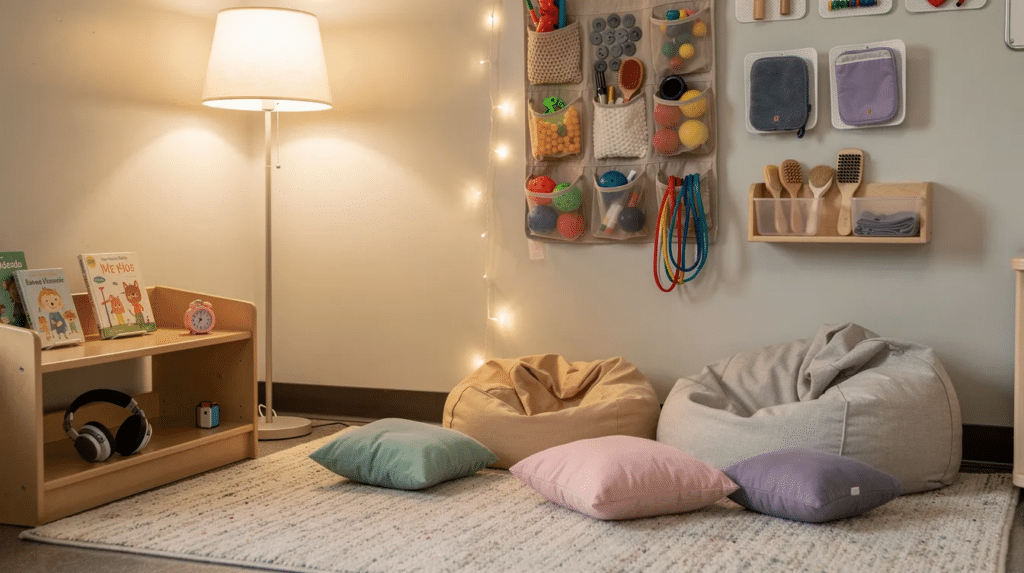
Calm-Down Corners are designated safe spaces within classrooms equipped with tools for students to regulate their nervous systems without feeling alienated.
For cognitive work:
Cognitive restructuring involves helping adolescents become aware of their thoughts, challenging unhelpful thoughts, and replacing them with more positive self-talk, which can be an effective coping strategy for anxiety.
Reframing self-talk encourages students to replace negative thoughts with positive affirmations and treat themselves kindly.
Positive self talk scripts:
“I’ve gotten through hard tests before.”
“It’s okay to be nervous and still do the presentation.”
“This feeling is uncomfortable, not dangerous.”
Encouraging students to brainstorm a variety of coping strategies and choose those that work best for them can empower them to manage their anxiety more effectively. Create a one-page coping menu with 10–15 student-selected ideas.
Research-backed social-emotional learning tools are available in Everyday Speech’s Teaching Calming Strategies Lesson Plan, and the Crisis Textline Student Mental Health Toolkit provides conversation starters and exercises organized by grade level.
Lesson 5: Modeling, Role Play, and Gradual Exposure
Modeling means an adult or peer demonstrates a skill before asking students to practice. Exposure means students gradually face anxiety triggers instead of avoiding them, starting with small steps.
A counselor or teacher might say out loud:
“I notice my heart beating faster before reading. I’m going to take two slow breaths and tell myself, ‘I can read one sentence.’”
Role play scenarios:
Presenting a project.
Joining a new lunch table.
Emailing a teacher about a missing assignment.
Responding to a group chat conflict.
Logging into Google Classroom after being absent.
Build a hierarchy:
Say “here” during attendance.
Ask one question after class.
Read one sentence aloud.
Share one idea in group work.
Give a 3-minute presentation.
Students should practice easier steps first. Offer choices: observe, work in pairs, write an imagined exposure, or try privately. Safety and consent matter; exposure should stretch students, not overwhelm them.
Lesson 6: Small Group Counseling and Family Collaboration
A small group of 4–8 students can normalize anxiety, strengthen relationships, and let youth exchange tips that actually work. Keep sessions structured and predictable.
A 4–6 session plan:
Week 1: understanding anxiety and emotional vocabulary.
Week 2: body cues and symptoms.
Week 3: coping strategies and deep breathing.
Week 4: social exposures and role play.
Week 5: exams, transitions, and school stressors.
Week 6: review, confidence, and next steps.
Send family summaries home:
“This week we practiced grounding.”
“Ask your teen to show one strategy before homework.”
“Notice effort, not perfection.”
Referral checklist for school staff:
Frequent school refusal or early checkouts.
Panic attacks that do not respond to basic support.
Depression, self-harm comments, or hopelessness.
Anxiety interfering with eating, sleep, class attendance, or relationships.
Need for documentation, caregiver contact, and referral pathways.
When impairment is severe, discuss more intensive care such as Adolescent Mental Health’s virtual IOP.
Adapting Anxiety Lesson Plans for Different Ages and Settings
Anxiety lesson plans should shift by age, setting, and learning profile.
Grades 4–6: use concrete visuals, “worry monster” drawings, short practice, and simple language.
Middle school: include friendship stress, changing bodies, grades, and social comparison.
High school: discuss perfectionism, identity, college pressure, family expectations, and social media.
General education: use 15-minute mini-lessons, warm-ups, or advisory routines.
Pull-out counseling: spend 45 minutes on practice, reflection, and feedback.
Neurodivergent students with ADHD or autism: use visual schedules, predictable routines, shorter steps, and options to respond by drawing, speaking, or writing.
Culturally sensitive teaching: avoid assumptions about family structure, faith, discipline, or how each home discusses health and anxiety.
Normalizing emotional vocabulary helps students articulate their anxieties and manage emotions more effectively.
Integrating Anxiety Education with Broader School Mental Health Efforts
Anxiety education works best when connected to SEL, anti-bullying work, trauma-informed practice, and schoolwide mental health routines.
Practical ways to integrate:
Start tests with a 2-minute breathing exercise.
Add a weekly “coping strategy share” in advisory.
Train staff to model positive self talk.
Coordinate between the counselor, psychologist, nurse, teachers, caregivers, and telehealth providers.
Collect anonymous pre/post surveys on anxiety knowledge and coping confidence.
Review risk factors such as bullying, trauma exposure, family stress, learning challenges, identity-based harassment, and chronic absenteeism.
CBT has strong research support for youth anxiety; a Cochrane review found CBT outperformed waitlist or no-treatment controls for children and adolescents with anxiety.

How Adolescent Mental Health Can Support Teens Beyond the Classroom
Some teens need more than classroom lessons, especially when anxiety includes school avoidance, severe panic, depression, self-harm risk, or major impairment.
Adolescent Mental Health’s virtual IOP supports ages 12–17 through secure video sessions, typically 3–5 days per week, including:
Family therapy and parent coaching.
CBT and DBT skill-building.
Flexible scheduling after school or in the evening.
Insurance coverage for many major plans.
Virtual therapy has become an increasingly popular option for adolescents seeking mental health support, particularly for issues like anxiety and depression. Evidence-based therapies such as Cognitive Behavioral Therapy (CBT) and Dialectical Behavior Therapy (DBT) are commonly utilized in virtual therapy settings to treat anxiety among adolescents.
Virtual therapy allows for flexible scheduling, making it easier for adolescents and their families to access mental health services without the constraints of traditional in-person appointments. With caregiver consent, schools can create a warm handoff so treatment goals align with classroom support.
FAQ
How long should an anxiety lesson plan be for middle school students?
Plan for 30–45 minutes: 5 minutes for warm-up, 10–15 minutes of teaching, 10–15 minutes of activity or role play, and 5 minutes to reflect. If the class period is short, split one lesson across two days.
Do I need formal mental health training to teach these anxiety lessons?
Teachers can teach basic psychoeducation and coping skills with approved materials. Diagnosis, treatment planning, and crisis decisions should stay with a counselor, social worker, psychologist, or licensed clinician.
How can I support a student who refuses role play?
Let the student observe, write a scenario, practice privately, or start with a very low-stress task. If avoidance is intense or persistent, check in individually and involve the school counselor and family.
What signs suggest school-based lessons are not enough?
Red flags include frequent school refusal, repeated panic attacks, self-harm comments, hopelessness, major sleep or eating disruption, or anxiety that blocks daily functioning. These signs call for a mental health evaluation and possible IOP referral.
Can these anxiety lesson plans work in virtual or hybrid classrooms?
Yes. Use polls, breakout rooms, digital body maps, shared slides, and online coping menus. Offer off-camera participation for socially anxious students and build in extra time for technology issues.